Ever found yourself peering at an old family tree, scratching your head over repeating names across generations? Or perhaps you're just starting your genealogical journey, hoping to make sense of those ancient Scottish records. You're in luck. Unraveling the past often begins with understanding the deeply ingrained Historical Scottish Naming Conventions & Practices. For centuries, Scots followed surprisingly consistent — and incredibly useful — patterns when naming their children, a tradition that offers invaluable clues for today’s family historians.
These weren't just arbitrary choices; they were a cultural blueprint, a way to honor ancestors and maintain familial ties long before formal records became commonplace. While these patterns weren't rigid laws and did evolve over time, grasping their logic can feel like being handed a master key to your ancestral lineage.
At a Glance: Your Quick Guide to Scottish Naming Patterns
- A Genealogical Goldmine: These patterns are a powerful tool for inferring ancestral names and identifying relatives, especially before the late 19th century.
- The Core System: Children were often named after grandparents, then parents, following a specific order for sons and daughters.
- Extending the Line: For larger families, names could reach back further to great-grandparents and beyond.
- Flexibility was Key: While common, the patterns weren't absolute. Life events like deaths, shared names, or even local influences could alter the sequence.
- Name Equivalents: Be aware that many names had common Scottish variations or interchangeable forms (e.g., Jane and Jean).
- Maiden Name Clues: Middle names sometimes preserved the mother or grandmother's maiden surname, offering another vital research lead.
The Ancestral Blueprint: Decoding the Core Naming Pattern
Imagine a time when family ties were everything, and remembering those who came before you was a sacred duty. This reverence was deeply woven into Scottish naming practices. Far from random, the names given to children often followed a predictable, albeit flexible, formula that paid homage to grandparents and parents first.
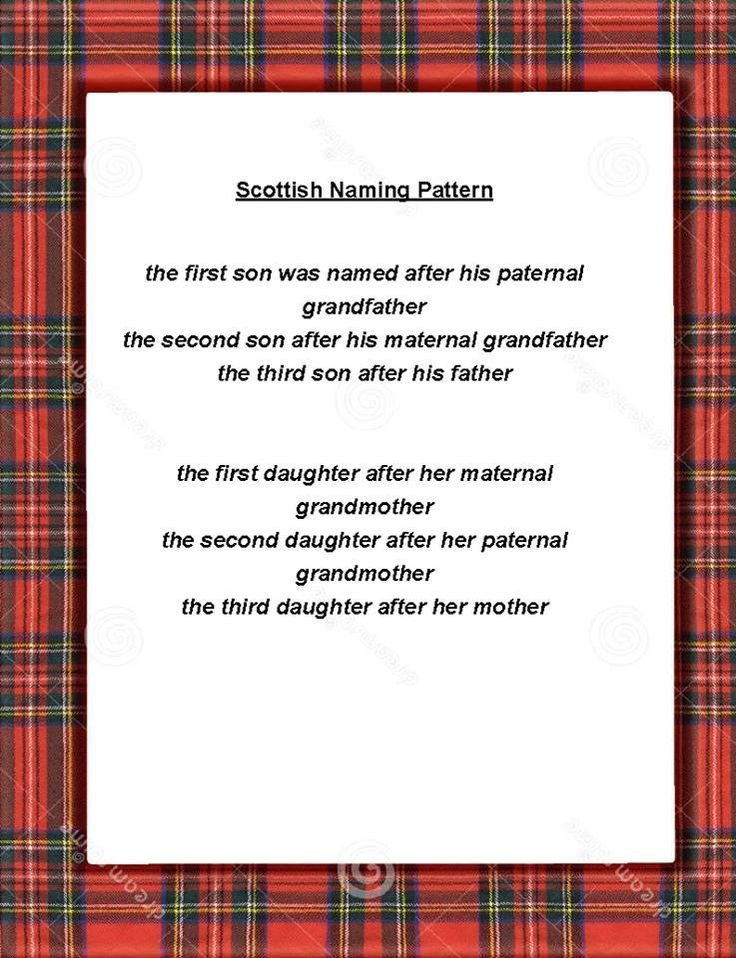
Here’s the fundamental structure that guided most Scottish families for generations:
- For Sons:
- The First Son: Almost always named after his paternal grandfather (his father's father).
- The Second Son: Typically named after his maternal grandfather (his mother's father).
- The Third Son: Usually bore the name of his father.
- Subsequent Sons: Named after other significant relatives, such as paternal or maternal uncles, or great-grandparents.
- For Daughters:
- The First Daughter: Generally named after her maternal grandmother (her mother's mother).
- The Second Daughter: Named after her paternal grandmother (her father's mother).
- The Third Daughter: Often took the name of her mother.
- Subsequent Daughters: Named after other important female relatives, like aunts or great-grandmothers.
This isn't just theory; it's a practical framework. Let's see how it plays out with a concrete example.
A Naming Scenario: The White & Forrest Union
Consider David White, whose parents were Andrew White and Mary Smith. David marries Jane Forrest, whose parents were Robert Forrest and Margaret Brown.
Based on the core naming pattern, their children would typically be named as follows:
- Boys:
- Their first son: Andrew (David's father's father).
- Their second son: Robert (Jane's mother's father).
- Their third son: David (the father).
- Girls:
- Their first daughter: Margaret (Jane's mother's mother).
- Their second daughter: Mary (David's father's mother).
- Their third daughter: Jane (the mother).
See how neatly the family lines are preserved? This structured approach means that even with fragmented records, you can often make educated guesses about potential ancestors.
Beyond the Third Child: Extending the Ancestral Reach
What about larger families, common in past centuries? Scottish families didn't stop at the third child when it came to honoring their lineage. The naming patterns could extend much further, drawing names from great-grandparents and even earlier generations. Genealogy expert John B. Robb's research, for instance, highlights how these patterns often reached deeper into the family tree, providing an even richer tapestry of clues for researchers.
While the exact order might vary slightly between families or regions, here's a generalized extension of the pattern for later children:
- Sons (Beyond the Third):
- Fourth Son: Might be named after the father's father's father (paternal great-grandfather).
- Fifth Son: Potentially named after the mother's mother's father (maternal great-grandfather).
- And so on... Other great-grandfathers from both paternal and maternal lines would then be considered for subsequent sons.
- Daughters (Beyond the Third):
- Fourth Daughter: Often named after the mother's father's mother (maternal great-grandmother).
- Fifth Daughter: Could be named after the father's father's mother (paternal great-grandmother).
- And so on... The pattern would continue, cycling through other great-grandmothers from both sides of the family.
This extended view underscores how deeply connected Scottish families felt to their ancestors, ensuring their names lived on through new generations. For anyone delving into their Scottish roots, understanding these layers is like having a hidden map.
When Tradition Bent: Factors That Altered the Rules
While these naming patterns were widely observed, they were never rigid laws carved in stone. Life, as it always does, brought circumstances that often prompted families to deviate from the 'rules.' Knowing these exceptions is just as important as knowing the pattern itself, as it helps explain apparent inconsistencies in your research.
Here are some common factors that could alter the traditional sequence:
- Honoring the Recently Deceased: If a beloved family member (a parent, grandparent, or even an older sibling) passed away shortly before or around the time a child was born, the new baby might be named in their memory, even if it meant skipping a 'scheduled' name.
- Reusing Names After a Child's Death: Infant and child mortality rates were tragically high in past centuries. If an earlier child died young, parents might reuse that name for a subsequent child of the same sex. This could lead to multiple children with the same name appearing in a family's records, a common source of confusion for genealogists.
- Shared Names Among Grandparents: What if both grandfathers were named John, or both grandmothers were named Mary? Families might then choose a different relative's name for the second child, or they might simply have two children named John or Mary, leading to potential duplicates within the same generation.
- Influential Figures: Naming a child after a respected clergyman, a kind midwife who assisted in the birth, or a skilled doctor who saved a life was not uncommon. These were people who had a significant impact on the family's life and were honored accordingly.
- Celebrated Public Figures or Friends: Occasionally, a child might be named after a dear friend, a local dignitary, or even a celebrated national figure. The heroic Florence Nightingale, for example, inspired many parents to name daughters after her, transcending traditional family names.
These deviations aren't roadblocks; they're valuable insights into the human element of historical records. They remind us that while patterns provide a strong framework, personal circumstances always held sway.
The Nuance of Names: Scottish Equivalents & Variations
One of the delightful, and sometimes challenging, aspects of Scottish genealogy is encountering names that appear to change form across records. It's crucial to remember that many names had common equivalents or interchangeable forms that were used fluidly within communities and families. This wasn't about changing one's name, but rather using a recognized variation.
Here’s a quick guide to some common interchangeable Scottish names you might encounter:
- For Males:
- Michael and Mitchell
- Patrick and Peter
- Also consider shortened or diminutive forms that might appear in casual use before becoming formalized: e.g., Alexander might be Sandy, James might be Hamish.
- For Females:
- Agnes, Ann, and Anne
- Christian and Christina
- Euphemia, Euphan, and Effie
- Fanny and Frances
- Grace and Grizel
- Jane and Jean
- Janet and Jessie
- Likewise, many female names had charming diminutives: Margaret might be Peggy or Maggie, Isabella might be Bella or Tibby.
When you see a seemingly 'new' name pop up in your family tree, especially for the second or third daughter, always consider if it might be an equivalent of a name you're expecting from the pattern. For a bit of fun and insight, you might enjoy exploring Our Scottish name generator to see various Scottish names and their origins.
The Power of the Maiden Name: A Middle Name Legacy
Middle names, while less rigidly patterned than first names, offer another fascinating avenue for genealogical detective work in Scotland. For later children, particularly in the 18th and 19th centuries, it was a common practice to use a mother's or grandmother's maiden surname as a child's middle name.
Imagine a child named "Andrew Campbell Fraser." The "Campbell" might not be a given name; it could very well be his mother's or grandmother's maiden name, providing a direct link to another branch of the family tree that might otherwise be harder to trace. This practice served to preserve important ancestral lines and honor maternal heritage, offering a vital clue for researchers.
Why This Matters for Your Research:
- Uncovering Lost Lines: A middle name that is clearly a surname could lead you directly to a female ancestor's maiden name, unlocking a whole new branch of your family tree.
- Confirming Connections: If you suspect a connection between two families, finding a maiden name from one family used as a middle name in the other can be strong corroborating evidence.
- Distinguishing Individuals: In families with many children sharing common first names (like John or Mary), a unique middle name can help you differentiate between siblings or cousins.
Always pay close attention to middle names in Scottish records. They are often more than just decorative additions; they are deliberate nods to family history, waiting to be uncovered.
Cracking the Code: How These Patterns Aid Genealogy
For anyone tracing their Scottish ancestry, understanding these naming conventions isn't just an academic exercise; it's a practical, powerful tool. By recognizing these patterns, you can transform fragmented records into a coherent narrative and overcome common research hurdles.
Here's how these patterns become your genealogical allies:
- Inferring Missing Names: If you have a marriage record for a couple but lack their parents' names, the names of their first few children can provide strong hints. If their first son is named "Robert," you can reasonably infer that the paternal grandfather (the father's father) was likely named Robert.
- Confirming Parental Identities: If you have several potential parents for an ancestor, matching the names of the first few children to the likely grandparents can help confirm the correct parental couple.
- Distinguishing Families: In areas where many families shared the same surname, the unique combination of first and second children's names, reflecting their specific grandparents, can help differentiate one "John Smith" family from another.
- Identifying Siblings and Cousins: When researching extended families, these patterns can help you hypothesize connections between different family groups, especially if a set of cousins share grandparent names.
- Navigating Limited Records: For periods before comprehensive civil registration (which began in Scotland in 1855), when only church records (births, marriages, deaths) were kept, these naming patterns become even more critical for piecing together family structures.
Remember, while these patterns are a fantastic guide, they are not foolproof. They are a strong indicator, a probability, rather than an absolute certainty. Always seek out primary source documentation to confirm your inferences.
Common Questions & Misconceptions About Scottish Naming
When delving into historical naming practices, it's natural to have questions. Here are some common queries and clarifications to help refine your understanding:
Did EVERY Scottish family follow these patterns?
No, not every single family followed them strictly. While widespread and deeply traditional, these were conventions, not legal requirements. Some families had personal reasons for deviating, such as a strong religious conviction leading them to name a child after a biblical figure, or simply a preference for a particular name. The patterns were more of a strong tendency than a universal law.
When did these naming patterns start to break down?
The influence of these traditional patterns began to wane significantly by the latter 19th century. With increased mobility, urbanization, and changing social norms, families started to exercise more personal choice in naming their children. By the early 20th century, while echoes of the patterns might still be found, they were no longer the dominant force they once were.
Are these patterns specific to certain regions of Scotland?
While the core patterns were generally observed across much of Scotland, local variations and influences certainly existed. For example, some regions might have had a stronger preference for certain saints' names, or Gaelic naming traditions might have intertwined differently in the Highlands versus the Lowlands. However, the grandparent-parent sequence remained the fundamental backbone almost everywhere.
Can I assume a child must be related if their name matches a grandparent?
No, you should never assume a definite relationship solely based on a name match. While the patterns make a strong case for a likely relationship, they are just that – a strong case. Always use this as a hypothesis to guide further research and seek out corroborating evidence like birth, marriage, and death certificates, census records, and wills. The patterns are a fantastic starting point, not an end point.
What if I can't find a record of a specific grandparent's name but the pattern suggests it?
This is a common scenario. If the naming pattern strongly suggests a grandparent's name (e.g., your ancestor's first son is "Andrew"), but you can't find a record for a paternal grandfather named Andrew, don't immediately dismiss the pattern. It's possible the record is lost, mistranscribed, or the grandparent used a different version of their name. Expand your search, look for other possible Andrew ancestors in the right time and place, and consider the 'equivalent names' discussed earlier.
Navigating Your Own Ancestral Journey: Beyond the Blueprint
Understanding Historical Scottish Naming Conventions & Practices is like acquiring a new pair of glasses for your genealogical research. What once looked like a jumble of names can now reveal a hidden order, guiding your search for long-lost ancestors. This framework provides invaluable context, transforming seemingly random data into meaningful clues.
As you embark on or continue your journey through Scottish family history, arm yourself with this knowledge. Use the naming patterns as a foundational guide, a strong hypothesis to test. But always remain open to the nuances and exceptions that make each family's story unique. By combining these traditional insights with diligent record-keeping and a curious mind, you’ll be well-equipped to unlock the rich narratives woven into your own Scottish heritage. Your ancestors are waiting for you to discover their stories.